PCB Assembly Challenges in Consumer Electronics Manufacturing
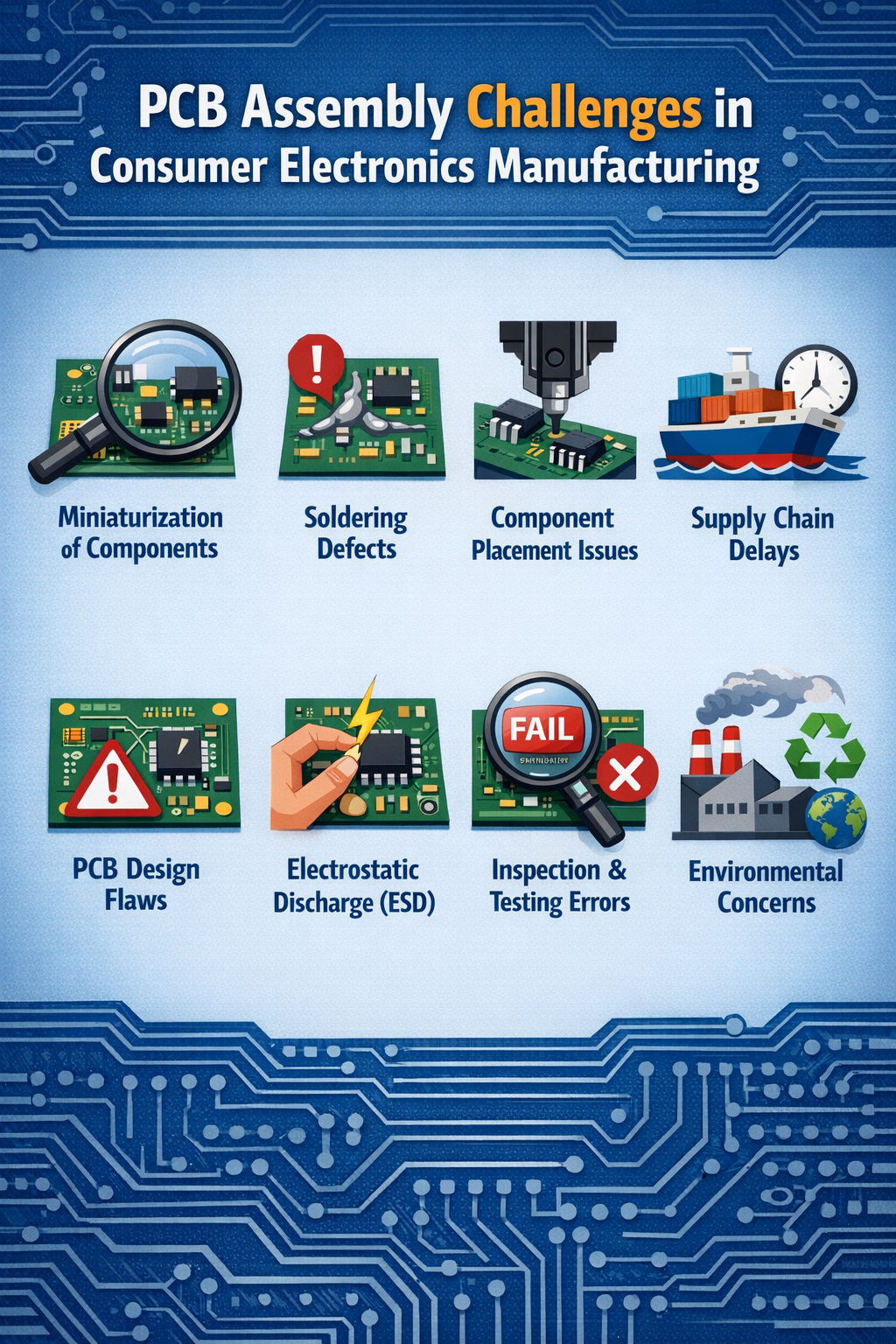
Consumer electronics products are evolving rapidly. Devices are becoming smaller, lighter, more powerful, and more feature-rich. From smart home systems and wearable devices to entertainment systems and kitchen appliances, innovation cycles are short and competition is intense.
Behind every finished product lies a complex manufacturing backbone supported by reliable PCB Assembly Services. In consumer electronics manufacturing, maintaining quality, cost efficiency, and speed simultaneously presents several technical and operational challenges.
This article outlines the major PCB assembly challenges in the consumer electronics sector and how structured PCB Assembly Services help address them.
1. Miniaturization and High-Density Designs
Consumer devices demand compact form factors, leading to:
- Fine-pitch components
- High-Density Interconnect (HDI) boards
- Microvias and multilayer stack-ups
- BGA and QFN packages
As component spacing decreases, the tolerance for error in solder paste printing, placement, and reflow reduces significantly. Even minor stencil or alignment variations can result in solder bridging or insufficient joints.
Advanced PCB Assembly Services rely on precise SMT programming, controlled reflow profiling, and strict process validation to manage miniaturized designs effectively.
2. High Volume with Short Product Life Cycles
Consumer electronics often have short market lifespans. New versions are launched frequently, requiring:
- Faster New Product Introduction (NPI)
- Rapid transition from prototype to mass production
- Scalable production lines
- Efficient production planning
Any delay in PCB assembly can directly affect time-to-market. Efficient PCB Assembly Services are structured to handle quick ramp-ups without compromising quality.
3. Cost Sensitivity and Margin Pressure
Consumer electronics operate on competitive pricing models. Cost control is critical.Key cost drivers include:
- Component sourcing volatility
- Panel utilization efficiency
- Yield losses and rework rates
- Testing methodology selection
Well-managed PCB Assembly Services focus on process optimization, yield improvement, and smart panelization strategies to balance cost and reliability.
4. Quality Expectations at Scale
Despite price sensitivity, consumers expect consistent product performance. Field failures can result in warranty claims, recalls, and brand damage.To maintain reliability at scale, PCB Assembly Services typically integrate:
- Automated Optical Inspection (AOI)
- In-Circuit Testing (ICT)
- Functional testing
- Statistical Process Control (SPC)
Maintaining high first-pass yield in large production volumes remains one of the most critical challenges.
5. Thermal Management in Compact Devices
Modern consumer electronics integrate powerful processors, batteries, and wireless modules within compact enclosures. This creates thermal concentration issues.Effective PCB Assembly Services work closely with design teams to ensure:
- Proper thermal via placement
- Copper balancing
- Optimized board stack-up
- Heat dissipation planning
Thermal oversight during assembly can reduce long-term product reliability.
6. Supply Chain Variability
Component shortages and lifecycle obsolescence directly affect consumer electronics production. High production volumes make these disruptions more impactful.Reliable PCB Assembly Services require:
- Strong supplier networks
- Alternate component validation
- Inventory forecasting
- Real-time procurement coordination
Supply chain stability is as important as assembly precision.
7. Testing, Firmware Integration, and Traceability
As devices become smarter and more connected, functional complexity increases. PCB Assembly Services must support:
- Firmware loading and validation
- End-of-line functional testing
- Serial number traceability
- Batch-level tracking
Traceability improves quality analysis and reduces post-market risk.
8. Frequent Design Changes
Consumer products evolve rapidly. Engineering change orders (ECOs) are common.Without early Design for Manufacturability (DFM) validation, design updates can disrupt production efficiency. Structured PCB Assembly Services integrate DFM review before production to minimize rework and improve yield stability.
Conclusion
PCB assembly in consumer electronics manufacturing is defined by precision, scalability, cost discipline, and speed. Miniaturization, high production volumes, and evolving consumer expectations increase technical complexity across every stage of the process.Reliable PCB Assembly Services address these challenges through:
- Early DFM validation
- Process automation
- Controlled SMT environments
- Advanced inspection systems
- Strong supply chain management
As consumer electronics continue to evolve, PCB Assembly Services must operate with equal agility, technical control, and manufacturing discipline.consumer electronics manufacturing
